
Ethan 周天宇

Ba (Hons) Interior & Environment Design - 2020 Cohort

My Design Philosophy

My name is Ethan, my pinyin name is Zhou tianyu. I am a university student at HBU university My interests have traveling. Because I think traveling is a good way to relax myself and see many interesting things and buildings. It can make me learn a lot and expand my design knowledge.

Honours Project - Community Integration

Project Brief

Integration of aging community - Organic Modular Construction

  • Issues to be addressed : key sentence explaining issues addressed 

  • Potentials : Possible potentials in a key sentence 

  • Design scheme : Key design scheme 

  • Structural : Key concept 

  • The final goals : Project goals not just for this project but for further designs

Idea Generation & Design Process

Generation

Bond

Elements

Development

Generation

Bond

Elements

Development

Slider image

Generational understanding

This is based on the situation of the increasing work pressure of young people, through the classification of different generations and understanding the behavioral habits of different generations, the elderly can be accompanied and the young can be relaxed. It is also a "bond" that connects the community together.

Slider image

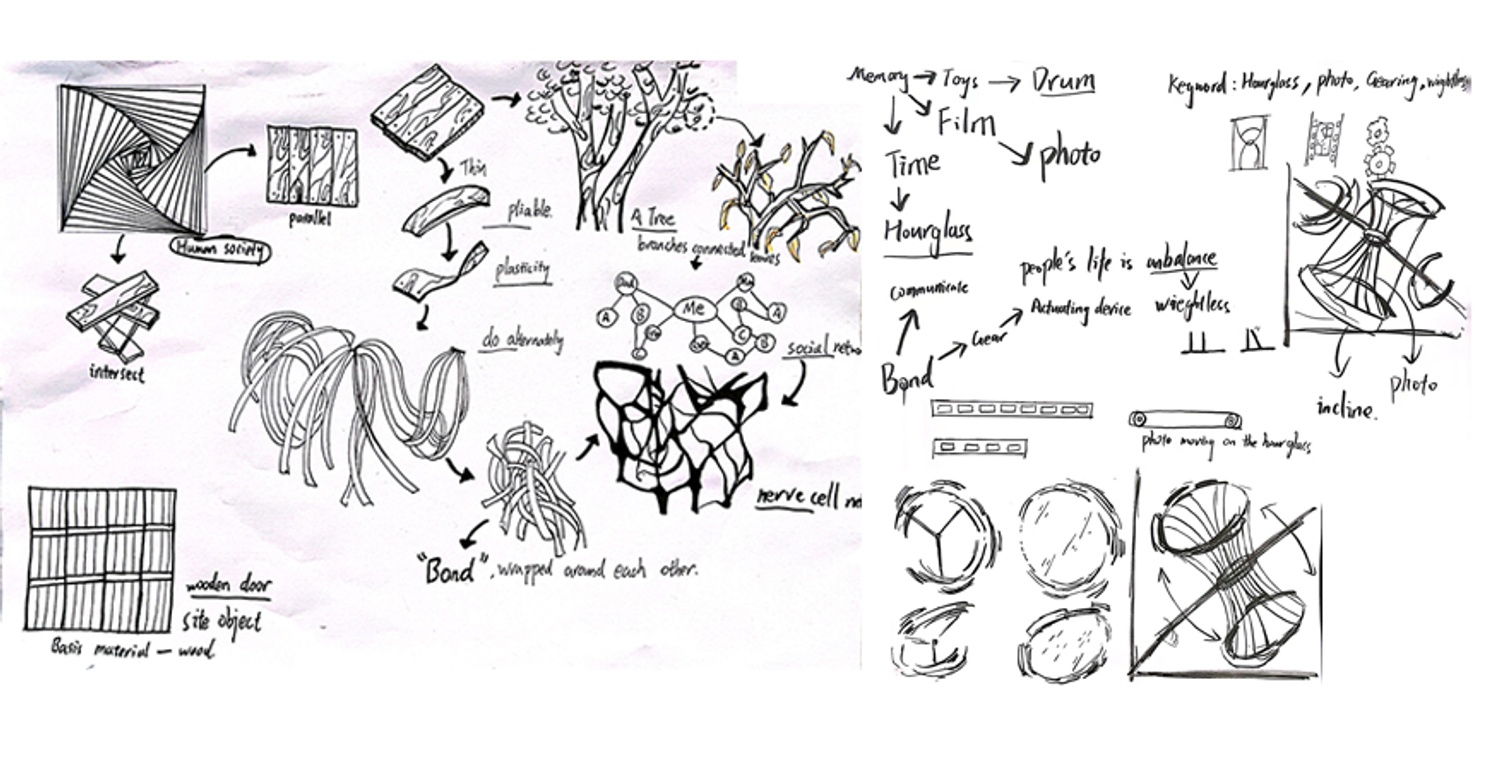
The concept of bond

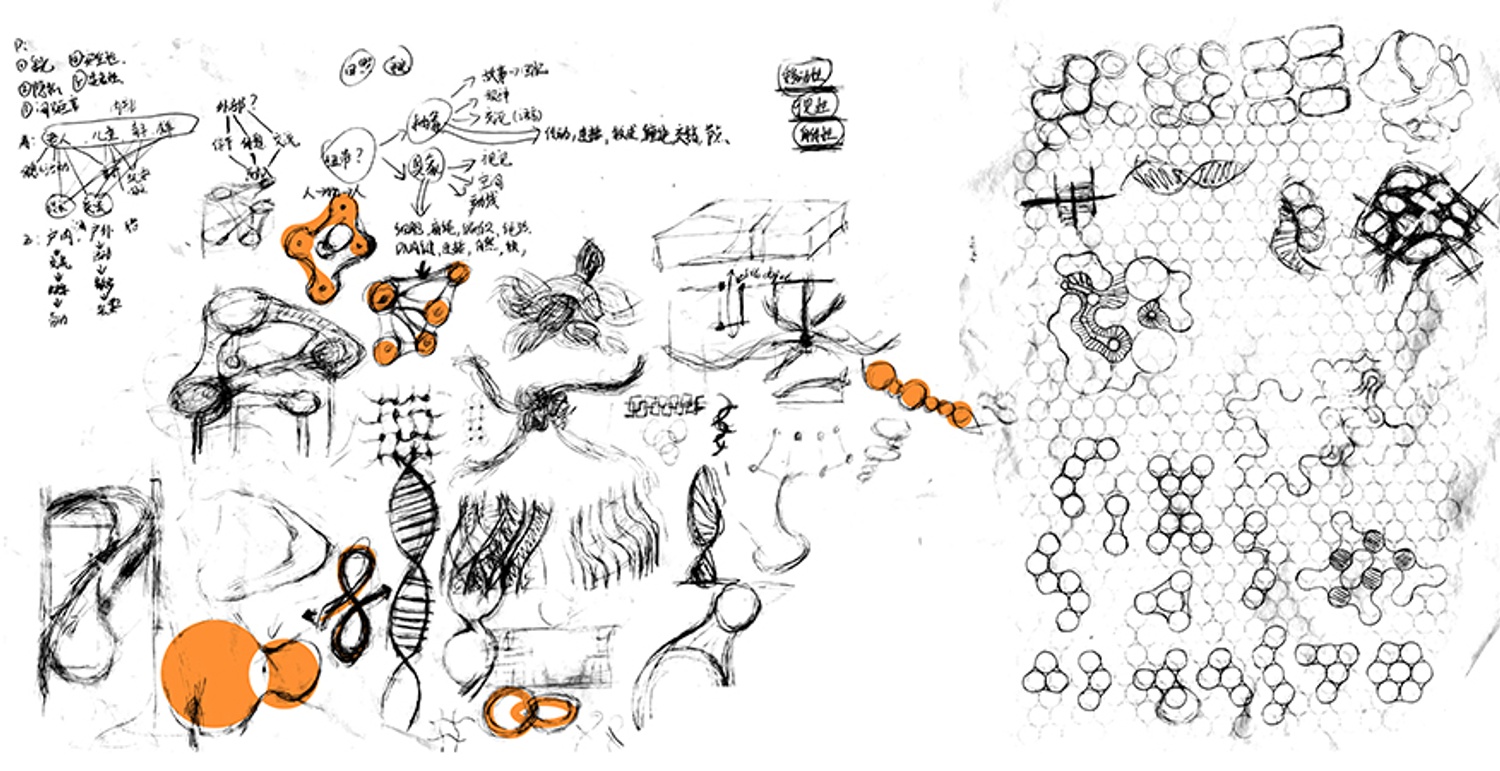
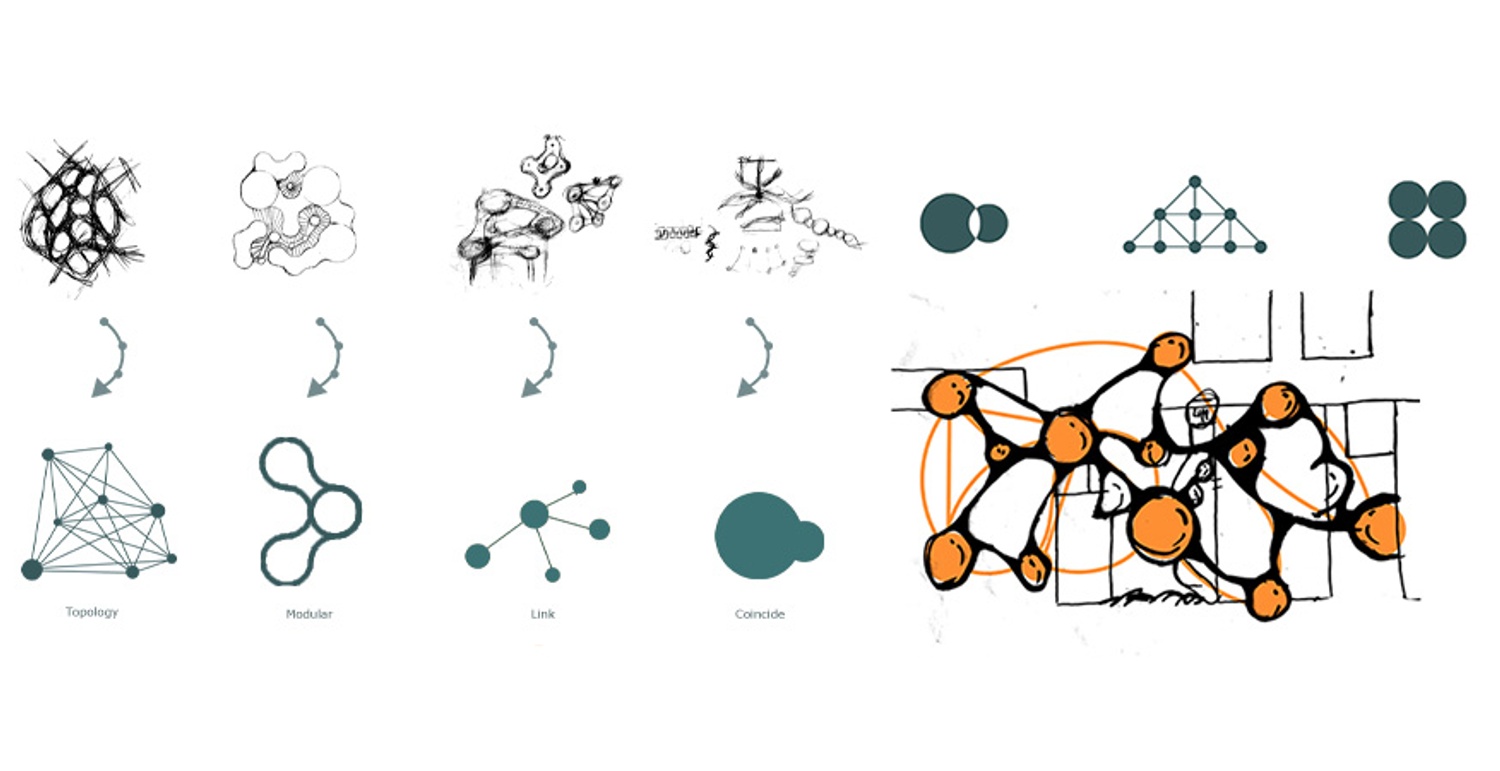
From the concept of bond, many elements are derived, including DNA strand structure, topology structure, knot structure, series structure. The elements are abstracted into the most basic geometric form and utilized. The elements are transformed from abstract to concrete.

Slider image

The extension of elements

Through the extension of the elements on the element board, many interesting forms can be obtained, and different elements are "defined" according to the needs of different groups, and elements are reinterpreted from both abstract and concrete perspectives. The design method of modularization is obtained, the community planning method is obtained

Slider image

Design development 

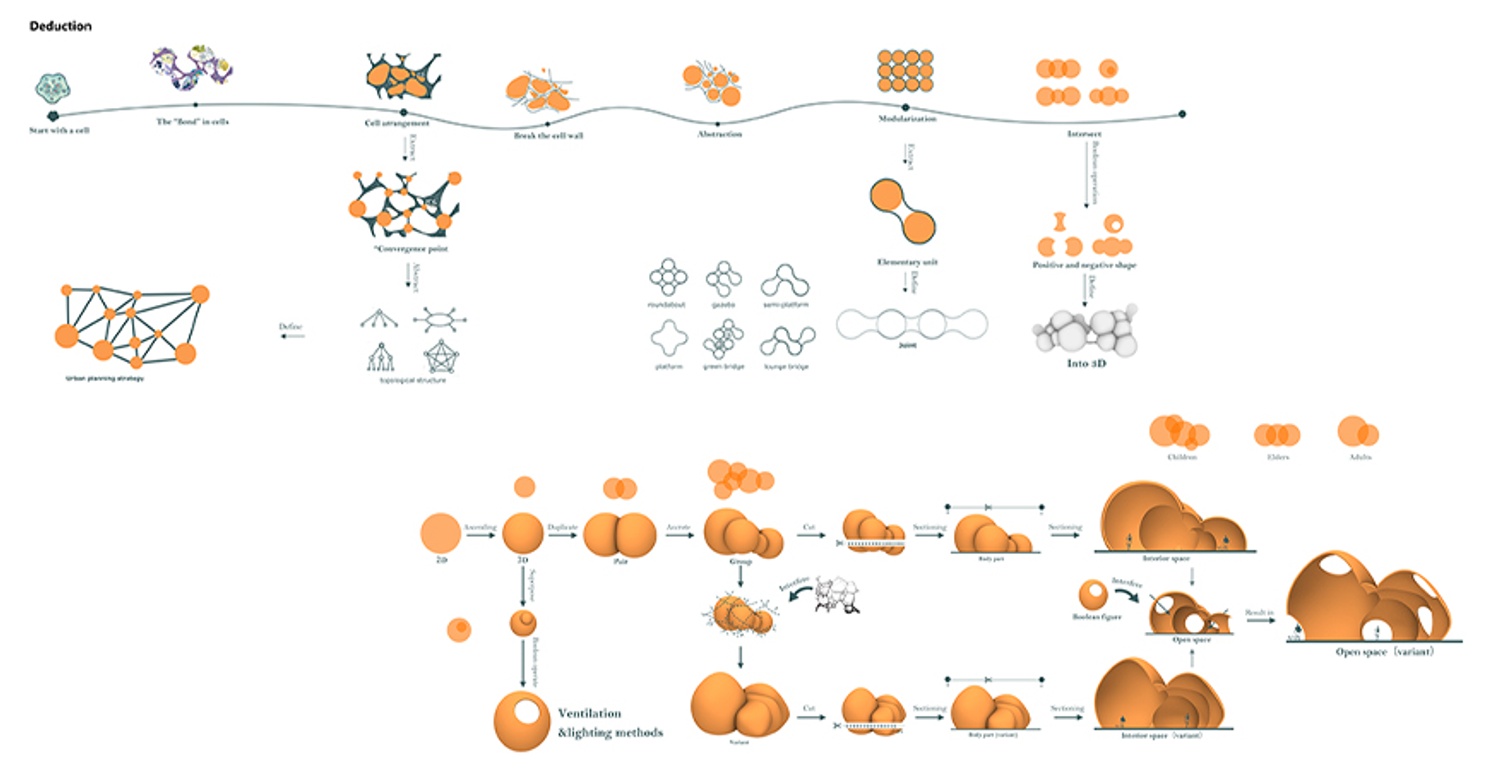
In this part, the three-dimensional space to be used in the design is developed based on the elements obtained from the transformation of two-dimensional graphics, and the body is analyzed based on the structure and operation methods (topological structure, Boolean operation method, modularity) obtained in two-dimensional.

Step 1 of 4

Final Design Scheme

Simple subtilite clear to the point 

Simple exploitation of the project 

Final Design Proposal

This community is clearly next to the next community, but it is cut off by a wall. Therefore, my design target is to take this community as the divergence point, radiate the surrounding communities in a planned way, break the "walls" in the community (physical walls and walls in people's minds) 

General Views

It is hoped that the design can change the gap between generations , and at the same time, it is hoped that the community can become a place full of children's laughter. And through the organic architectural form, rich space, break the cold appearance of modern architecture, and awaken people

Video Portfolio

Show the beauty with picturesque video portfolios. It will help people experience every scene.

Context, Site analysis, Design Narratives and Concept

Get to know the thorough design development from the stages listed below.

Community Project - Participant’s Installation

Design Narrative

Students theme  This design is a specially customized punch card device for community service centres. The overall structure adopts a modern and simple style, with white as the main colour, supplemented by gold decorative strips, which is both simple and modern. The punch card device consists of a number of inclined planes at different angles, which are not only aesthetically pleasing, but also ergonomic, allowing users to punch in from different directions. Each panel in the design has been carefully calculated and arranged to ensure ease of operation and robustness of the device. The base is wide and stable, which can effectively prevent movement or tilt due to frequent use. In addition, the height and tilt angle of the device are designed to accommodate users of different heights, ensuring that everyone can use it comfortably. This punch-in device is not only practical, but also adds a touch of beauty to the community service centre through its unique design aesthetics, making daily check-in a pleasure.

Honours Project - Site Research and Representation

Part I: Research and Analysis

The building site is located in an old residential area with a long history, and the surrounding environment is complex and varied. On the north side is a long-abandoned factory whose old buildings and facilities have been partially demolished, and the remaining structures pose a safety hazard to the area. On the east side is a new neighbourhood under development, with modern residential buildings contrasting with the old neighbourhood, heralding the rapid urban renewal that the area is undergoing. The south and west sides are mainly residential buildings in old neighbourhoods, most of which were built in the eighties and nineties of the last century, with relatively old facilities, but the residents have frequent community activities and a strong community cultural atmosphere. The region's infrastructure is in dire need of improvement, including greenery, roads and public facilities. Due to the transformation of the economic and social structure of the region, it has gradually become a key area for urban renewal. The contrast between old and new buildings, the inhabitants of different generations, and the potential development opportunities all make this site an interesting case study of urban planning and architectural design, with great potential for research and renovation.

Part II: Site Representation

Narrative: 

In this project, the designers cleverly used cantilevered structural elements to give the building a unique visual levitation effect. The cantilever structure not only enhances the building's modernity but also makes efficient use of limited space, creating open and dynamic public realms. This design element is particularly prominent in the context of the old community, bringing new vitality and possibilities to the otherwise oppressive, closed environment. Through the cantilever design, part of the building is cantilevered beyond the boundaries of the main structure, which not only optimizes the spatial layout of the building but also provides the necessary shelter for the public areas below, increasing the space for outdoor activities. This design has played a positive role in improving the quality of life of the residents of the community, making the area a focal point for residents' social interaction. In addition, the use of a cantilever also reflects the sensitive use of existing building conditions, demonstrating a modern interpretation and challenge of traditional architectural language in a complex urban environment.  

Honours Project

Theoretical Underpinning

Part I: Self-expression and group identity used by Gen Z media

'...the labyrinth's complex paths symbolize the process of young people finding their place in the world of social media'

The labyrinth

With its labyrinthine structure, the work allegorically and visually depicts the self-expression and exploration of group identity of contemporary Generation Z. The labyrinth's complex paths symbolize the process of young people finding their place in the world of social media, with each turn representing an opportunity for new self-discovery and a sense of belonging to a group.

The figure at the centre may represent every individual who has the courage to express themselves in the digital age, while the intricate walls around them are like waves of social media, both as a challenge and as a stage for the younger generation to express themselves. This artwork reflects how Gen Z can find resonance and belonging in a collective culture while maintaining their individual uniqueness.

Part II: The background of Pre-generation Z and its relevance to Generation Z

'....Each cut and fold represents the deposition and vicissitudes of time, while the overall streamlined shape symbolizes the continuity between the past and the present.'

Relevance to Generation Z

This group of artworks illustrates a visual narrative of intergenerational transmission and contrast. The complex and layered structure conveys the historical context of the pre-Z generation (i.e., millennials) and their connection to Gen Z. Each cut and fold represents the deposition and vicissitudes of time, while the overall streamlined shape symbolizes the continuity between the past and the present. These works allow viewers to explore the experiences of previous generations while reflecting on the characteristics of Gen Z – including their innovativeness, reliance on technology, and the quest for personalization. The opening and closing of each space is not only a continuation of the ideas of the previous generation, but also a symbol of the reform and redefinition of the new generation. Through this artistic language, the work speaks of intergenerational dialogue and influence, emphasizing the importance of understanding the past in shaping the future.

Part III: The commonalities and contradictions between Pre-generation Z and Generation Z

'Each cascading construct not only bridges the past and the future, but also maps how media forms have evolved to adapt to changing ways of communicating and receiving information.'

The ability to connect generations of media forms

Through their coherent and contrasting design language, this group of sculptures reveals the commonalities and contradictions between pre-Z and Gen-Z, while demonstrating the ability to connect across generations of media forms. The streamlined shapes and repetitive curved elements symbolize the continuity of history and the inheritance of culture. The rupture and turning point in it represent the conflict and opposition between old and new ideas. The overall design reflects the similarities and confrontations between different generations in terms of values, expressions, and use of technology.

Each cascading construct not only bridges the past and the future, but also maps how media forms have evolved to adapt to changing ways of communicating and receiving information. This artwork is not only a visual exploration of tradition and modernity but also a profound reflection on how different generations find resonance in the evolution of media

To Explore, Discover, & Regenerate